This paper is not yet on arXiv — the submission is pending sponsor endorsement in math.NT. The LaTeX source above is the exact file prepared for that submission (5 pages, no external figures or .bib required), provided here so anyone can read, compile, check, or independently submit it. This page will be updated with the arXiv link once endorsement is obtained.
Abstract
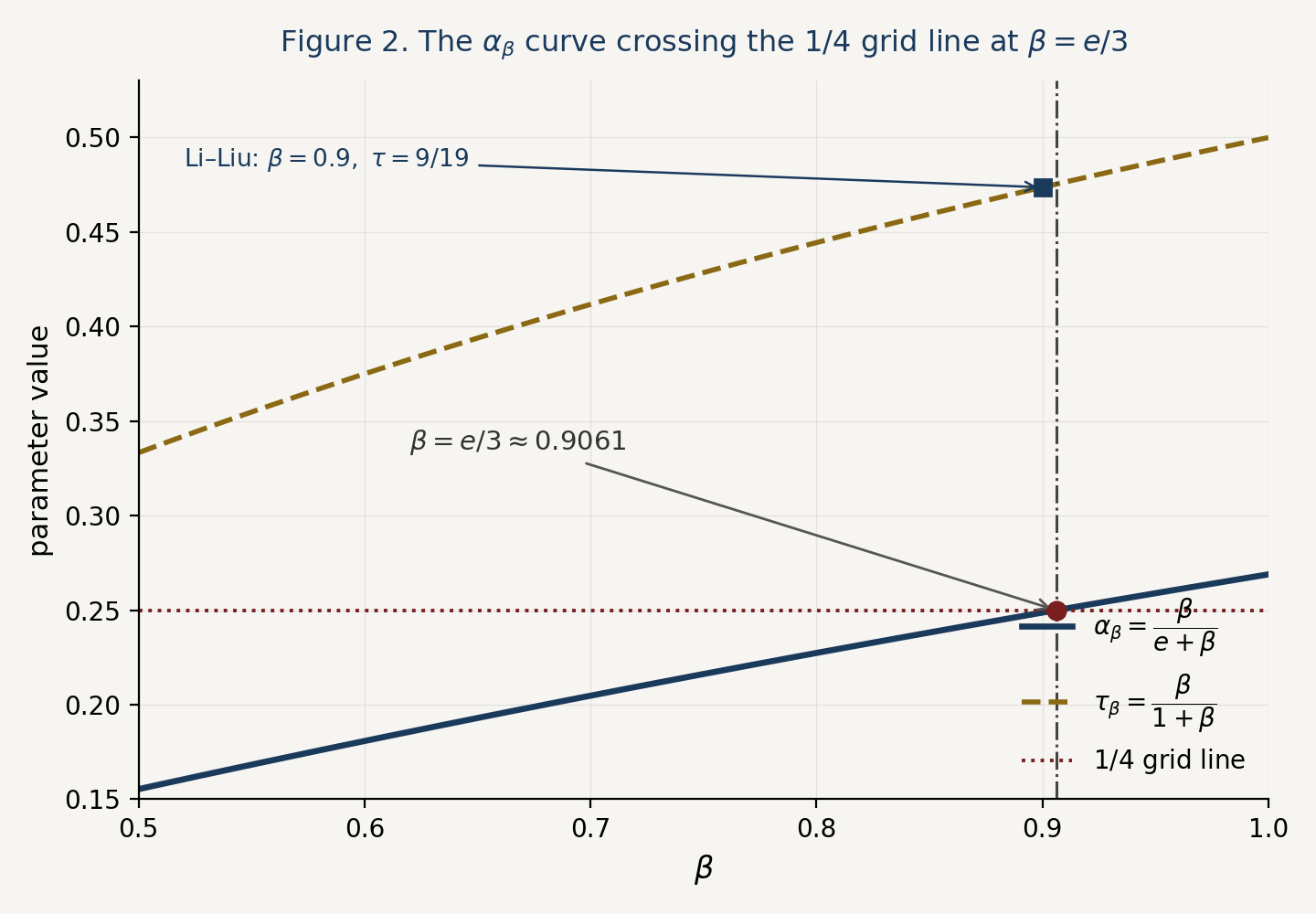
For a real parameter $\beta \in (1/2,1)$, unbalanced-semiprime geometry ($n=qr$, $q\le r^\beta$) produces the exponent $\tau_\beta = \beta/(1+\beta)$, and a model prime/semiprime mass-balance integral, set equal to $1$, produces $\alpha_\beta = \beta/(e+\beta)$. We show that the one-parameter Ford–Maynard triple built from these — $\gamma_\beta=1/(1+\beta)$, Type-II interval $[\alpha_\beta,\tau_\beta]$ — lies in the domain of Ford and Maynard's Theorem 2.2 (On the Theory of Prime-Producing Sieves, arXiv:2407.14368) for every such $\beta$, that their condition (A2) holds automatically, and that their rational-cover condition (A1) holds if and only if $\beta \le e/3$. The unique obstruction, throughout the admissible range, is the denominator $4$ — verified both by direct proof and by exhaustive search over denominators $3$ through $200$. We compare this threshold with Jiamin Li and Jianya Liu's 2026 unconditional $(1+1.9)$ Goldbach refinement (arXiv:2606.05224), whose sieve-optimization parameter $\tau=9/19$ coincides algebraically with $\tau_\beta$ at $\beta=0.9$ — itself just below $e/3\approx0.9061$. We show this is a same-formula correspondence arising from an identical exponent-balance structure in two independently motivated constructions, not a shared proof or citation link: Li–Liu's paper does not invoke Ford–Maynard's machinery, and their exponent $1.9$ is the output of an independent weighted-sieve optimization. No unconditional Goldbach theorem is claimed.
With $\theta_\beta=\alpha_\beta=\dfrac{\beta}{e+\beta}$ and $\theta_\beta+\nu_\beta=\tau_\beta=\dfrac{\beta}{1+\beta}$, Ford–Maynard's rational-cover condition (A1) holds for the entire admissible range $\tfrac12<\beta<1$ except that it fails at exactly one denominator, $n=4$, precisely when $$ \beta > \frac{e}{3} \approx 0.90609.$$
1. Introduction
1.1 Two unrelated-looking thresholds
Ford and Maynard's 2024 paper On the Theory of Prime-Producing Sieves [FM] gives a clean necessary-and-sufficient combinatorial criterion — conditions (A1) and (A2) below — for when Type I/Type II information of a given shape $(\gamma,\theta,\nu)$ is enough, on its own, to force the correct asymptotic count of primes in a sequence. Independently, in their unconditional improvement of Chen's theorem toward binary Goldbach, Li and Liu [LL] optimize a Chen-style weighted sieve over several numerical exponents and land on $\tau = 9/19$ as part of their $(1+1.9)$ result.
We show that a natural one-parameter family of Ford–Maynard triples, built directly from elementary unbalanced-semiprime counting and a simple heuristic mass-balance calculation, has $\tau_\beta = 9/19$ at $\beta=0.9$ — matching Li–Liu's exponent exactly — and that this family's rational-cover criterion (A1) transitions from holding to failing exactly at $\beta=e/3\approx0.9061$, a hair's breadth above $\beta=0.9$. Every step below was checked directly against the primary source texts.
1.2 What this paper is and is not
This paper (i) derives $\tau_\beta$, $\alpha_\beta$ from elementary counting and a heuristic mass-balance integral; (ii) proves, against Ford–Maynard's Theorem 2.2 exactly as stated, that the resulting family sits in their domain, that $M(\gamma_\beta)=2$, that (A2) holds identically, and that (A1) holds iff $\beta\le e/3$; (iii) locates $\beta=0.9$ just inside the admissible region; (iv) states precisely, via Ford–Maynard's own Theorem 2.2(b), what "the criterion fails" does and does not imply; and (v) states explicitly what would still be needed to say anything about binary Goldbach.
This paper is not: a new sieve-theoretic result, a strengthening of Chen's theorem, a strengthening of Li–Liu's theorem, or a step toward Goldbach's conjecture. It is a parameter-level structural observation, offered as a conservative "we have not located this in the literature" synthesis.
2. Unbalanced semiprime geometry
Let $n=qr\asymp N$ with $q\le r$ primes, and impose the unbalance condition $q\le r^\beta$ for $\beta\in(1/2,1)$. Write $q=N^{u+o(1)}$, $r=N^{v+o(1)}$. Since $n\asymp N$, $u+v=1+o(1)$, and the unbalance condition gives $u\le \beta v+o(1)=\beta(1-u)+o(1)$, so $u(1+\beta)\le\beta+o(1)$, i.e.
This is elementary exponent bookkeeping — a statement about the size regime of the smaller prime factor — not a theorem about integers.
3. Prime–semiprime model balance
Define $I(\alpha,\beta)=\displaystyle\int_\alpha^{\beta/(1+\beta)}\frac{dt}{t(1-t)}$. Using $\frac1{t(1-t)}=\frac1t+\frac1{1-t}$ and $1-\tau_\beta=\frac1{1+\beta}$ (so $\tau_\beta/(1-\tau_\beta)=\beta$):
$$I(\alpha,\beta)=\log\!\left(\beta\cdot\frac{1-\alpha}{\alpha}\right).$$Setting $I(\alpha,\beta)=1$: $\beta(1-\alpha)/\alpha=e \Rightarrow \alpha(e+\beta)=\beta$, giving
Classification (important). This is a model mass-balance threshold — a Buchstab/sieve-density-flavored heuristic, exact as an integral evaluation but not an unconditional statement about primes or semiprimes. Sections 2–3 hand $\tau_\beta,\alpha_\beta$, as precisely defined real numbers, into the rigorous Ford–Maynard criterion of Sections 5–9; the heuristic motivation and the rigorous result are logically independent.
4. The one-parameter Ford–Maynard family
Set $\gamma_\beta=\dfrac1{1+\beta}=1-\tau_\beta$ (immediate from (2.1)). Define
The Type-II interval is $[\theta_\beta,\theta_\beta+\nu_\beta]=[\alpha_\beta,\tau_\beta]$.
5. The Ford–Maynard theorem, quoted exactly
Ford and Maynard [FM, §2.2] define, for
$$\mathcal Q := \Big\{(\gamma,\theta,\nu): \big(\tfrac12\le\gamma\le1-\theta-\nu \text{ or } 1-\theta\le\gamma<1\big) \text{ and } \big(0\le\theta<\theta+\nu\le\tfrac12 \text{ or } 0\le\theta<\tfrac12,\ \theta+\nu=1-\theta\big)\Big\},$$and $(\gamma,\theta,\nu)\in\mathcal Q$, the quantity $M=\lfloor 1/(1-\gamma)\rfloor$, and the two conditions:
For all integers $n\ge M+1$, there exists $a\in\mathbb N$ with $a/n \in [\theta,\theta+\nu]$.
For some positive integer $h$, $h(1-\gamma) \in [\theta,\theta+\nu]\cup[1-\theta-\nu,1-\theta]$.
(a) If both (A1) and (A2) hold, then $C^-(\gamma,\theta,\nu)=C^+(\gamma,\theta,\nu)=1$: any non-negative sequence satisfying the Type I and Type II estimates automatically satisfies $\sum_p w_p \ll_A x/(\log x)^A$ for every $A$ — the abstract data alone forces the correct-order count of primes.
(b) If either (A1) or (A2) fails, there is $\delta>0$ such that for all large $x$ one can construct bounded non-negative sequences $a_n^\pm$ satisfying the same estimates with $\sum_p a_p^-\le(1-\delta)\sum_{x/2
This is the exact statement specialized below; see Appendix B (audit note) for confirmation that it was checked line-by-line against arXiv:2407.14368.
6. Proof: admissibility and denominators 3, 4, 5, ≥6
So (A1) concerns all integers $n\ge 3$.
Denominator 3
Denominator 4 — the binding constraint
Denominator 5
Denominators n ≥ 6
Let $L(\beta)=\tau_\beta-\alpha_\beta$.
Numerical confirmation (Section 6.5)
We searched, at 30-digit precision, all denominators $n=3,\dots,200$ and all numerators $a=1,\dots,n$ across a grid of $\beta$ spanning $(1/2,1)$. For every tested $\beta\le e/3$ (including $\beta=e/3-10^{-6}$), no denominator failed. For every tested $\beta>e/3$ (up to $\beta=0.9999$), the unique failing denominator was $n=4$. This is a check, not a substitute for the closed-form proof above.
7. Condition (A2)
Because (A2) is automatic here, whether Theorem 2.2(a) or 2.2(b) applies is decided entirely by (A1) — i.e. entirely by the denominator-4 question above.
8. Main theorem: the e/3 rational-cover threshold
For $\tfrac12<\beta<1$, let $P_\beta$ be as in (4.2). Then $P_\beta\in\mathcal Q$, $M(\gamma_\beta)=2$, (A2) holds identically, and (A1) holds if and only if $\beta\le e/3$. Consequently, by Ford–Maynard's Theorem 2.2,
$$C^-(P_\beta)=C^+(P_\beta)=1 \quad\text{for } \tfrac12<\beta\le e/3,$$while for $e/3<\beta<1$ there exist, for every sufficiently large $x$, bounded non-negative sequences realizing the same Type I/Type II data with $C^-(P_\beta)<1
Every hypothesis of Ford–Maynard's Theorem 2.2 has been checked against the source text, not assumed (Sections 6–7).
![Horizontal bars showing the interval [alpha_beta, tau_beta] against denominator grid points 1/6, 1/5, 1/4, 1/3, 2/5 for several values of beta](emf-dft-fig1-rational-cover.png)
9. Necessity, and what "(A1) fails" does and does not mean
For $e/3<\beta<1$: $\alpha_\beta>1/4$ and $\tau_\beta<1/2$, so neither $1/4$ nor $2/4$ lies in $[\alpha_\beta,\tau_\beta]$; by Section 6, $n=4$ is the only denominator that can fail, so (A1) fails only there.
For $\beta>e/3$, Type I/Type II information of exactly this shape is not enough, by itself, to pin down the correct-order count of primes: bounded non-negative sequences exist, satisfying the identical estimates, whose implied "prime count" is provably too small or too large by a fixed factor. This is a statement about the limits of the abstract framework at this parameter shape — not a claim that prime production is impossible for any concrete sequence, and it says nothing by itself about Goldbach, Chen's theorem, or Li–Liu's theorem.
10. The endpoint β = 1
At $\beta=1$, $\tau_1=1/2$, so $2/4=1/2=\tau_1$ re-enters the closed interval as its right endpoint — (A1) at $n=4$ holds again exactly at $\beta=1$, even though it fails throughout $(e/3,1)$. This is a genuine jump discontinuity driven by the closed-interval convention in (A1); it is not a contradiction, and the family's own derivation (Section 2) in any case degenerates at $\beta=1$, where $q\le r^1=r$ imposes no unbalance at all. We note, without pursuing it further, that this resembles the boundary phenomena Ford–Maynard's own Theorem 2.3 studies for the set $\mathcal A$ of triples where $C^\pm=1$; we have not verified their condition (B) for this family and make no claim beyond what Theorem 2.2 itself gives.
11. The Li–Liu (1+1.9) specialization
Li and Liu [LL, Thm 1.1, eq. (5.1)] prove unconditionally that every sufficiently large even $N$ can be written $N=p+rq$ with $r\le q^{0.9}$, $p,q$ prime and $r$ prime or $1$, via a weighted sieve with $\tau=(a-1)/a-\varepsilon=9/19-\varepsilon$ at $a=1.9$.
Observation. Li–Liu's formula $\tau=(a-1)/a$ is algebraically identical to $\tau_\beta=\beta/(1+\beta)$ under $\beta=a-1$ — both encode the same unbalanced-almost-prime bookkeeping. Setting $\beta=0.9$ reproduces $\tau=9/19$, $\gamma=10/19$ exactly:
$$\frac{e}{3}-0.9\approx0.0060939, \qquad \gamma_{0.9}-\frac12=\frac{10}{19}-\frac12=\frac1{38}.$$So $\beta=0.9$ lies just inside the admissible side of the $e/3$ transition — by less than a hundredth.
Correct reading:
For the $\beta=0.9$ specialization, the associated Type-I parameter $10/19$ lies exactly $1/38$ above the classical square-root level, and Li–Liu's exponent, expressed in our $\tau_\beta$ parametrization, sits inside — but close to the edge of — the region where this unrelated Ford–Maynard family's condition (A1) holds.
Not supported:
Only 1/38 remains to prove Goldbach.
Three independent reasons this inference fails:
- Different proof architecture. Li–Liu's Theorem 1.1 uses Chen's classical linear-sieve machinery — well-factorable coefficients, Buchstab's function, an explicit twelve-term weighted inequality (their Proposition 4.3) — with numerically optimized exponents. Their paper never cites or uses Ford–Maynard's abstract rational-cover theorem. The match at $\tau=9/19$ is a coincidence of the formula $\beta/(1+\beta)$ under $\beta=a-1$, not evidence that Li–Liu's proof is bounded by a denominator-cover obstruction.
- Different objects entirely. Ford–Maynard's Theorem 2.2 concerns whether abstract Type I/Type II data of a shape is sufficient to force an asymptotic; it says nothing about whether the Goldbach representation function actually satisfies such estimates, nor about numerical sieve constants. "$e/3$" and "$1/38$" are not distances in the same currency as "distance from Goldbach."
- The actual bottleneck is the switching principle, not a rational-cover count. Li–Liu's own §8.1 states plainly: "to this day we still have no proof of Proposition $(1+2)$ that completely circumvents the switching principle" — the real obstacle separating Chen's theorem from binary Goldbach in their framework. No sharpening of a rational-cover parameter closes this gap.
We have not located, in either [FM] or [LL], any indication that Li–Liu's choice $a=1.9$ was constrained by or aimed at a Ford–Maynard-type rational-cover boundary. The near-coincidence $0.9 Modern distribution context. Li–Liu's unconditional result combines the classical Bombieri–Vinogradov level $1/2$ with the Bombieri–Friedlander–Iwaniec well-factorable level $4/7$ [BFI], plus a weighted Bombieri–Vinogradov form due to Pan–Ding [PD] for switching-principle error terms; their conditional Theorem 1.3 assumes a weighted Elliott–Halberstam hypothesis WEH$(0.999)$. They explicitly note that Pascadi's exceptional-spectrum mean-value theorem [Pas], despite a nominally higher distribution level, supports only upper-bound sieve weights and is therefore unusable in their proof, which needs lower-bound weights (their §3, Lemma 3.3) — a concrete illustration that numerical exponents from different papers are not interchangeable without checking coefficient class. These are not independent confirmations of a hidden structure; they are the same algebraic fact stated twice. Once $\theta_\beta=\alpha_\beta$ is fixed and $1/4$ is the only relevant grid point given $M=2$, the two "views" are the same computation in different vocabulary. We describe this as a reformulation, not a coincidence between independent structures. The individual components are standard: unbalanced-almost-prime counting exponents, the mass-balance integral $\int dt/[t(1-t)]$, and Ford–Maynard's Theorem 2.2 (cited and used exactly as stated). We have not located, in the prior literature, the specific identification $\theta_\beta=\alpha_\beta$, $\theta_\beta+\nu_\beta=\tau_\beta$, $\gamma_\beta=1-\tau_\beta$ carrying a mass-balance parameter directly into Ford–Maynard's rational-cover framework, nor the resulting denominator-4/e/3 identification and its numerical proximity to Li–Liu's exponent. We describe this conservatively as a potentially novel synthesis of known components, not a new theorem in sieve theory or analytic number theory. We have exhibited, and fully verified against both primary sources, a one-parameter family of Ford–Maynard triples whose rational-cover criterion (A1) — governed, throughout the entire admissible range, by the single denominator $4$ — transitions at exactly $\beta=e/3$. This threshold sits just above the parameter value that reproduces, via an identical exponent-balance formula, Li and Liu's 2026 unconditional Goldbach-refinement exponent $\tau=9/19$. The two facts are connected only at the level of a shared algebraic formula, not at the level of proof, and nothing here moves the needle on binary Goldbach itself. [FM] K. Ford and J. Maynard, On the Theory of Prime-Producing Sieves, arXiv:2407.14368v1 (2024). [LL] J. Li and J. Liu, Theorem (1+1.9) on the Goldbach Conjecture, arXiv:2606.05224v2 (2026). [BFI] E. Bombieri, J. Friedlander, H. Iwaniec, Primes in arithmetic progressions to large moduli, Acta Math. 156 (1986), 203–251. [PD] C. D. Pan and X. X. Ding, A new mean value theorem, Sci. Sinica, Special Issue II on Math. (1979), 149–161. [Pas] A. Pascadi, Large sieve inequalities for exceptional Maass forms and the greatest prime factor of $n^2+1$, arXiv:2404.04239v2. [Chen] J. R. Chen, On the representation of a large even integer as the sum of a prime and the product of at most two primes, Sci. Sinica 16 (1973), 157–176.12. Interpreting the double appearance of e/3
View Calculation Result 1 — Model mass balance Solve $I(\alpha,\beta)=1$ for $\alpha$; set $\alpha_\beta=1/4$; solve for $\beta$ $\beta=e/3$ 2 — Rational-cover obstruction Find where $1/4$ leaves $[\alpha_\beta,\tau_\beta]$ $\beta=e/3$ 13. Limitations — what has not been established
14. Novelty and relation to prior work
15. Conclusion
References