Find the connections
Learn to navigate the arena and use polarity to change available routes.
Historical showcase — no live game execution.
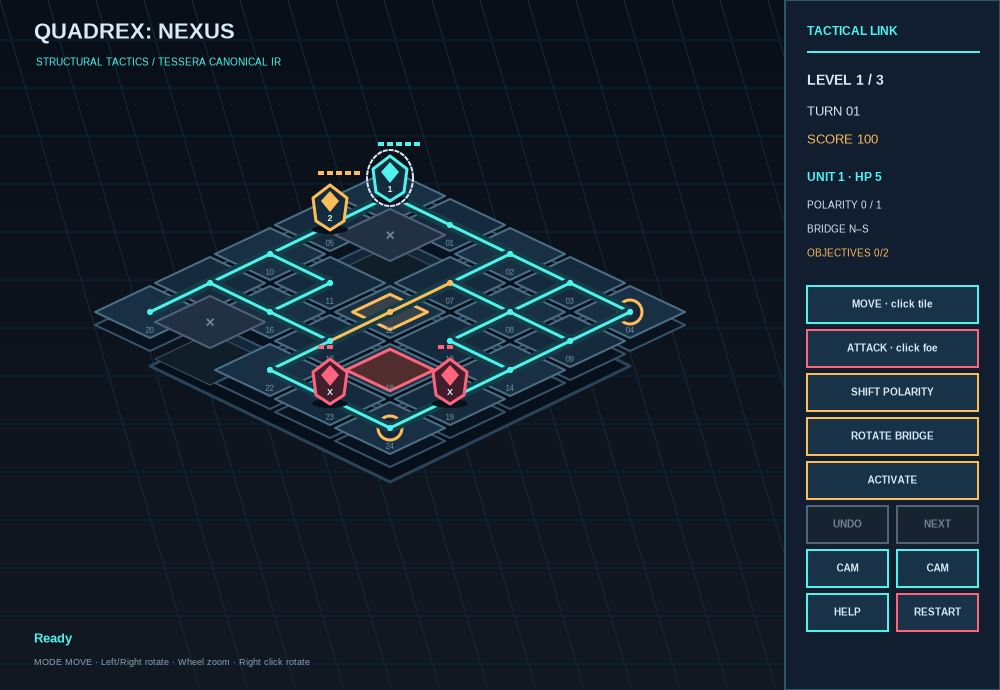
Guide two friendly units along connected tiles, confront deterministic opponents and activate two objectives. Wall density increases across the three levels, changing the space available for navigation.
Learn to navigate the arena and use polarity to change available routes.
A denser arrangement of walls changes how the units approach their objectives.
The densest arena in the campaign asks you to combine movement, bridge control and combat.
These are descriptions of the original campaign, not separate browser simulations.
Select a cyan or amber unit, then click a connected adjacent tile to move. Opponents respond deterministically on even turns.
In the original desktop implementation, Tessera rules determine movement, combat, polarity, bridge behavior, scoring, opponents and victory. Python hosts the Tessera runtime and supplies the graphical interface, input and local save handling.
The preceding description refers to the original desktop application. This page serves static presentation assets and does not connect to a Tessera backend.
Nexus illustrates a division between gameplay decisions expressed in Tessera and host-language presentation. It is a bounded research application, not evidence of universal computational advantage or mathematical novelty.
Related research examines structural relationships, orientation, constraints and exact reconstruction. Existing bounded comparisons preserve conventional-equivalence and negative findings. No claim of a prime-specific computational advantage or a new theorem is made here. Nexus is distinct from the separate Prime Quadrex implementation.
The recovered Windows/Python 3.13 record reports seven Nexus rule tests passed. It describes rejected actions, movement/rendered-link agreement, combat, polarity and bridge constraints, undo, save/reopen, win/loss, and victories with live opponents across all three levels.
| Measurement | Reported value |
|---|---|
| Checked-IR load | 1,457.06 ms |
| Median action | 36.99 ms |
| 95th-percentile action | 45.09 ms |
| Maximum action | 51.33 ms |
| Peak traced Python allocations | 1.63 MiB |
100 alternating polarity/undo commands, including JSON save replacement, measured with allocation tracing. These figures are not browser latency, total process memory, server throughput or a general performance comparison.
Rights remain with their respective owners. No license is granted by this showcase; applicable law and express licenses remain unaffected. Disclosure and licensing policy.